DRINKING WATER
New EU Drinking Water Directive (DWD)
From the perspective of drinking water safety, as the European Union continues to tighten its requirements on health and environmental protection, “drinking water safety” is no longer limited to water quality alone, but now extends to the entire supply chain, including all materials and products that come into contact with water.
Among the most critical regulations is the EU Drinking Water Directive (DWD).
The revised EU Drinking Water Directive (EU 2020/2184), which entered into force in 2021, is being progressively implemented, with key requirements—particularly those related to materials in contact with drinking water—taking effect from 2026–2027. These changes will have significant implications for materials, equipment, piping systems, and related components, including lubrication-related materials used in water-contact applications.
What is DWD?
From the Old Directive to the Revised Framework
Previous Directive (1998) – Directive 98/83/EC
The original directive primarily focused on:
- Drinking water quality (i.e., whether water is safe for human consumption)
- Limited and non-harmonized requirements for materials in contact with drinking water
- National-level regulations, resulting in fragmented standards across EU member states
Revised DWD (EU 2020/2184)
The most significant change in the revised directive is the shift from focusing solely on “water quality” to a broader approach that also covers materials and products in contact with drinking water.
Key additions include:
- Hygiene requirements for materials in contact with drinking water
- Migration limits (to prevent substances from leaching into water)
- No adverse impact on odor and taste
- Control of organic substance release (e.g., TOC)
- Increased attention to emerging contaminants, such as PFAS and endocrine-disrupting compounds
Industry Impact
These changes directly affect a wide range of components used in water systems, including:
- Sealing materials (e.g., elastomers, O-rings)
- Plastics and polymer-based components
- Metallic materials
- Lubrication-related materials used in water-contact applications
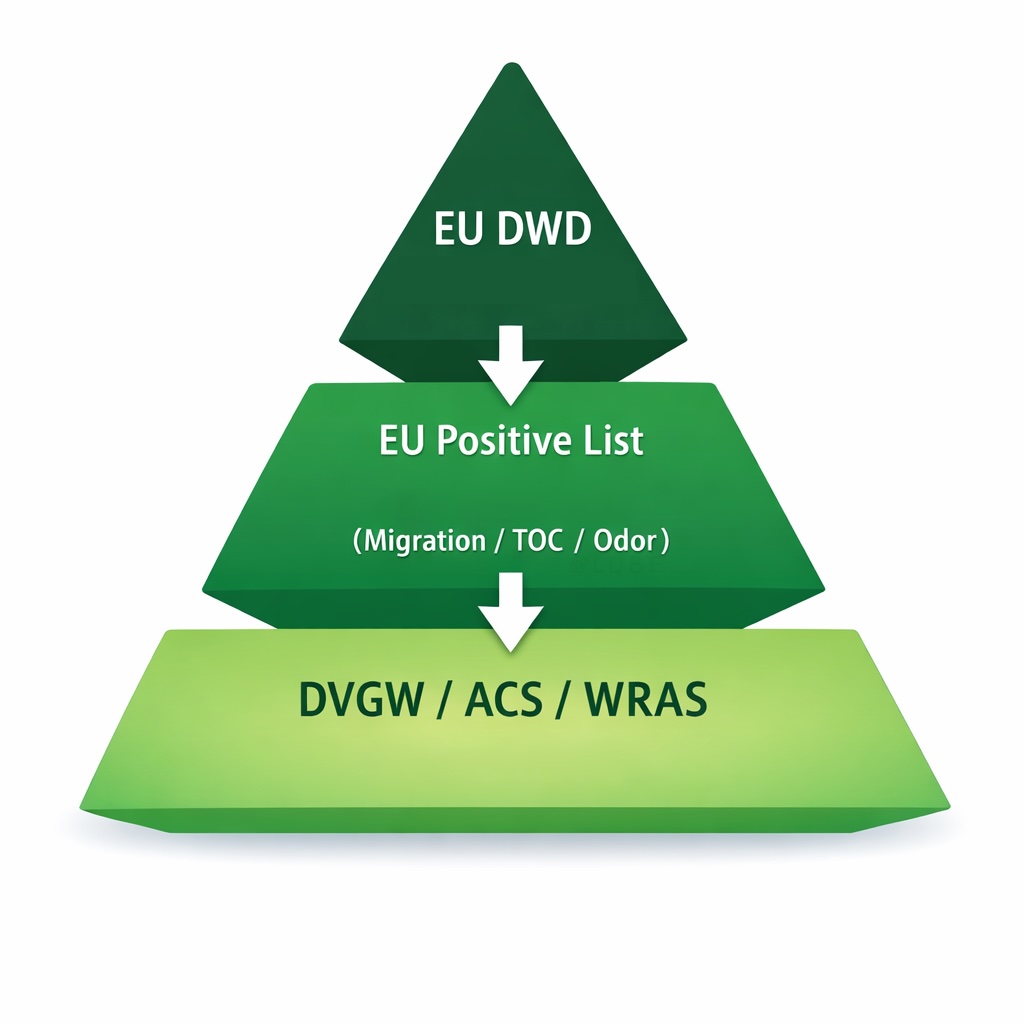
Will the EU Drinking Water Directive (DWD) Replace DVGW / ACS / WRAS in the Future?
They will not disappear, but will become more harmonized and integrated:
Harmonized Testing Methods (Migration / TOC / Odor)
(Certification and Market Acceptance)
Why Did DVGW / ACS / WRAS Develop?
Under the previous regulatory framework (Directive 98/83/EC), while drinking water quality was regulated at the EU level, there was no harmonized EU-wide system specifically governing materials in contact with drinking water.
As a result, each member state developed its own certification and approval schemes, such as DVGW in Germany, ACS in France, and WRAS in the United Kingdom.
In essence, these systems reflect national approaches to defining and verifying compliance with drinking water safety requirements for materials.
| Country ⬍ | Certification System ⬍ | Key Features ⬍ |
|---|---|---|
| Germany | DVGW / KTW | Strict technical requirements, with a strong focus on material migration and microbiological control |
| France | ACS | Regulation-driven system with rigorous approval procedures |
| United Kingdom | WRAS | Widely used in engineering applications with strong market acceptance |
Key Takeaways
- The EU Drinking Water Directive (DWD) is the overarching regulatory framework for drinking water within the European Union
- Its requirements—particularly for materials in contact with drinking water—will be progressively implemented from 2026–2027 onward
- A core objective is the harmonization of material safety requirements across the EU
- Existing national schemes such as DVGW, ACS, and WRAS will not disappear, but are expected to become aligned and integrated within the new framework
- The industry is currently in a critical transition period
Our qualifications
Brugarolas Food-grade Lubricant Range
NSF
NSF-certified lubricants are specially formulated for use in industries where incidental food contact may occur, ensuring compliance with food safety regulations. NSF H1 (safe for incidental food contact), NSF 3H (direct food contact, such as release agents), making them essential in food processing, pharmaceuticals, and beverage industries.
WRAS/DVGW/ACS
We offer a comprehensive portfolio of products compliant with WRAS, DVGW, and ACS, specifically designed for use in components of drinking water systems, supporting your compliance with current standards as well as the upcoming EU Drinking Water Directive (DWD) requirements.
Halal
Halal refers to anything that is permissible or lawful under Islamic law (Shariah), particularly concerning food, beverages, and other consumables. In the context of food, halal ensures that products are free from prohibited substances (such as pork and alcohol) and are processed according to Islamic guidelines, including humane animal slaughter. Also apply to cosmetics, pharmaceuticals, ensuring ethical and religious compliance.
MOSH/MOAH free (Available now)
Since these years, more and more countries are requiring MOSH/MOAH(mineral oils hydrocarbons) free products, we are available to provide your food industrial solutions.